
Ship production-grade analytical AI agents
The harness for building powerful AI agents on top of your data product.





Schema information, knowledge and metrics become typed catalog entities the agent can act on.
sources
ingestingtable:products
metric:revenue-calculation
knowledge:pricing-constraints
knowledge:discount-policy
rel:orders_products
data-quality:missing-products
identity
tenant=acme · workspace=analytics
select name, revenue from products
ARR
$0.0M
Optimized tools for catalog search, schema inspection, relation traversal, and read-only SQL queries.
All agent actions and accesses resolve through the active tenant/workspace.
[ Problem ]
Your product has rich data. Agents still can’t do real work with it.
Exclude test data before 2021
Elasticity must use log-normal demand model
Revenue calculations exclude refunds
Customer segments use fiscal year boundaries
The meaning of the data lives outside the schema
Metric definitions, formulas, temporal rules, tenant logic, and exceptions are scattered across docs, dashboards, and people’s heads.
rebuild_segments
Recompute customer segments
run_forecast_model
Quarterly revenue forecast
update_price_tiers
Update 1,240 price records
trigger_usage_resync
Backfill usage events
apply_fx_rates
Refresh currency conversions
Actions turn agent mistakes into product risk
Agents trigger jobs, update records, and run simulations. Without permissions and approvals, a bad interpretation becomes a product incident.
Generic agent loops break customer-facing products
Open-ended tool exploration burns tokens and adds latency. “Eventually correct” is too slow and breaks the user experience.
[ Platform ]
A purpose-built harness to make your data product AI-native
flowai-harness gives engineering teams production-ready defaults for agents that reason across complex data environments, plan reliably, and execute actions safely.
[ 01 DATA ]
Data catalog for AI agents
Profile databases and organizational knowledge into one searchable graph of tables, columns, joins, metrics, and docs.
Agents use it to resolve intent, find the right data, and ground queries in tenant-scoped context.
[ 02 PLANS ]
Primitives for safe action execution
Define typed plan and action schemas. The runtime validates the plans and runs them as state machines. Plans are persisted and status is tracked for full auditability.
[ 03 RUNTIME ]
A runtime for data-heavy agents
A Rust-native harness for analytical agents, built on our high-performance agent framework.
It brings plans, approvals, tools, evaluations, and context management into one fast runtime.
[ 04 STUDIO ]
Run, debug, evaluate, and improve agents
Flow AI Studio is the native UI for flowai-harness agents: inspect runs, traces, evals, and changes from one workspace.
Use the dev Studio locally, then move to Enterprise Studio for production teams.
[ 05 SELF-IMPROVING AGENTS ]Coming soon
Propose, test, promote, repeat
Turn eval failures, traces, and near misses into improvement candidates.
Each candidate runs in isolation, is scored against your benchmark, and either becomes the new baseline or informs the next research wave.
[ Integrations ]
Works with the stack you already run
Bring your own models, warehouse, and cloud. Flow AI runs inside your infrastructure — your keys, your region, no data leaving your systems.
Models
OpenAI, Anthropic, Gemini, Llama, Mistral, Qwen, and more
Data
Postgres, Snowflake, BigQuery, Databricks, DuckDB
Clouds
AWS, Azure, GCP
Deployment
On-premise or SaaS
Data residency
EU or US

[01]
models






[03]
deployment
On-prem
SaaS
[04]
data residency


[02]
hosting




[ About us ]
Built by early pioneers in generative AI
From the original generative writing assistant to industry-leading evaluation models, we've spent years turning LLMs into reliable, real-world products.

Flow AI is joining Aiven
Today, we are announcing that Flow AI has been acquired by Aiven. The story and our thinking behind the decision.

How to transform your SaaS into an assistant-native platform
How to turn your data-heavy SaaS into an assistant-native platform that plugs into Claude and ChatGPT via a semantic context layer and action layer.
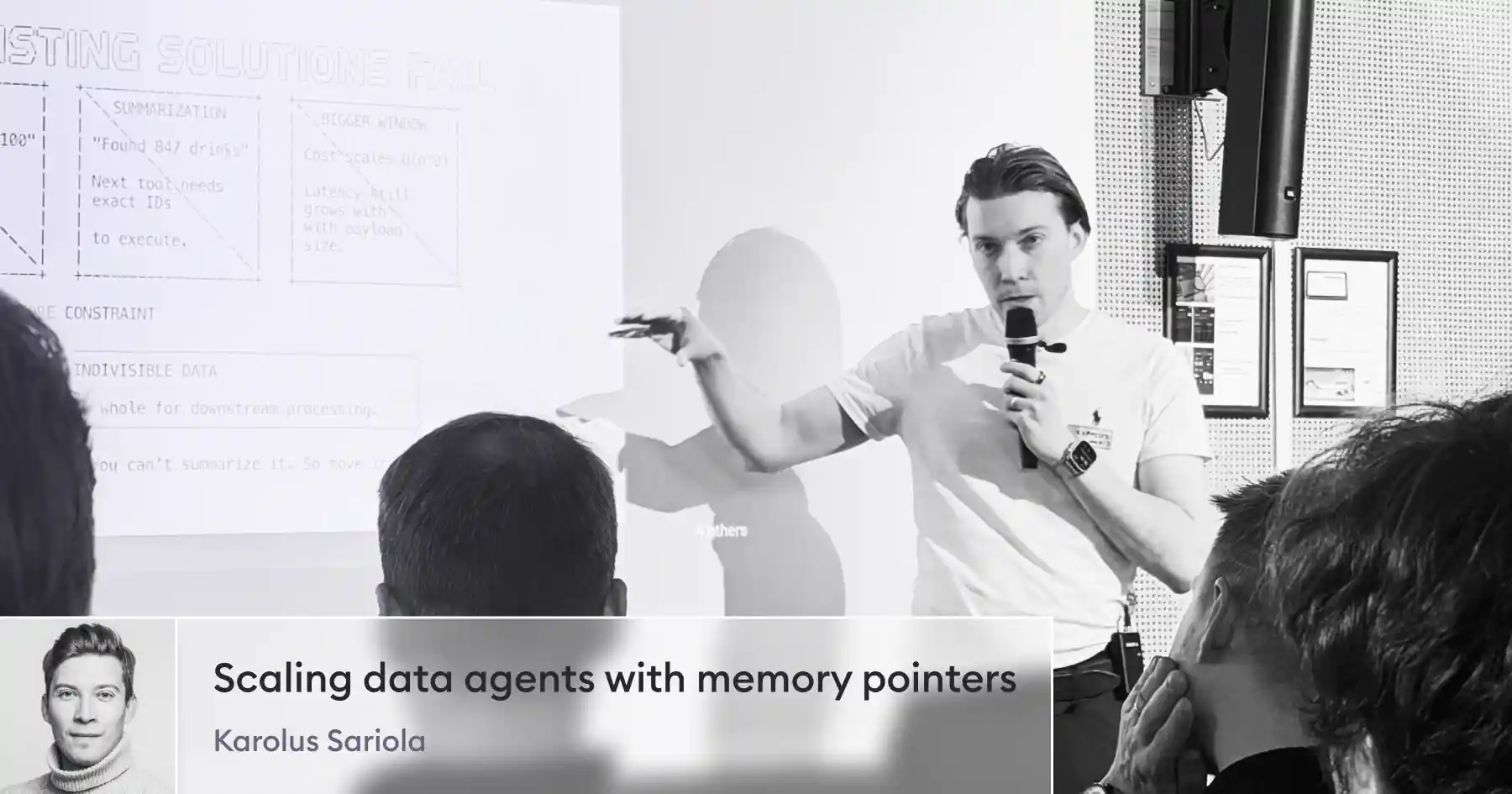
Scaling data agents with memory pointers
Notes from our Context is King meetup talk on using memory pointers and semantic glimpses to keep data agents fast.